All meetings
NDNComm 2015 In person

NDN Community Meeting 2015

September 26–29, 2015 Little Theater, Macgowan Hall, UCLA Campus, Los Angeles, CA, USA Hosted by UCLA

University of California at Los Angeles hosted the second NDN Community Meeting in the last week of September 2015.

Recordings

Full-length recordings of the meeting.

Day 1 September 28, 2015
Day 2 September 29, 2015

Program

Select a talk to read its abstract.

Day 1

Saturday, September 26
  1. 9:00 AM

    Hackathon Breakfast

  2. 10:00 AM – 10:10 AM

    Project Idea Pitches

  3. 10:10 AM – 12:30 PM

    Form small groups based on interests; Hack

  4. 12:30 PM – 6:00 PM

    Lunch, then Hack

  5. 6:00 PM

    Dinner and unwind social event (TBD)

  6. 8:00 PM
    Closing

    Close Hackathon Saturday

Day 2

Sunday, September 27
  1. 9:00 AM

    Hackathon Breakfast

  2. 10:00 AM – 12:30 PM

    Hack

  3. 12:30 PM – 5:30 PM

    Lunch, then Hack

  4. 5:30 PM – 6:30 PM

    Project judging

  5. 6:30 PM – 8:30 PM

    Dinner and committee meeting

  6. 8:30 PM – 9:00 PM

    Award presentation

  7. 9:00 PM
    Closing

    Close Hackathon Sunday

Day 3

Monday, September 28
  1. 8:00 AM

    Breakfast

  2. 9:00 AM – 9:45 AM
    Keynote

    Keynote: NDN - Past, Present, Future

    Jeff Burke (UCLA School of Theater, Film and Television), Van Jacobson (UCLA)

    • The Future of the Internet is the Future of Storytelling Jeff Burke (UCLA School of Theater, Film and Television)
  3. 9:45 AM – 10:15 AM
    Session

    Architecture Achievements

    • NFD Development Progress Beichuan Zhang (University of Arizona)
  4. 10:15 AM – 10:45 AM
    Session

    Data-Centric Security

    • Schematized Trust: Design and Application Alex Afanasyev (UCLA)
    • Content-Base Confidentiality: lessons learned in the past year Yingdi Yu (UCLA)
  5. 10:30 AM

    Break

  6. 10:45 AM – 11:20 AM
    Session

    NDN-NP Applications

    • NDN-NP Applications Update Jeff Burke (UCLA REMAP)
    • NDN-RTC Peter Gusev (UCLA)
  7. 11:20 AM – 12:00 PM
    Session

    Science and NDN

    • Science Data and the NDN paradigm (remote presentation) Inder Monga (ESnet)
    • Managing Scientific Data with NDN Susmit Shannigrahi (Colorado State University)
    • (Possible) HEP Use Case for NDN Phil DeMar (FermiLab)
    • An NDN Testbed for Large-scale Scientific Data in Korea Huhnkuk Lim (KISTI)
  8. 12:00 PM

    Working Lunch / Hackathon Project Demos

  9. 1:00 PM – 2:00 PM
    Session

    Lightning Talks (5min each advertising for posters/demos)

    • PartialSync: Synchronizing a Partial Namespace in NDN Minsheng Zhang (University of Memphis)
    • Hyperbolic vs. Link-State Routing in ICN Vince Lehman (University of Memphis)
    • Japan-EU Joint Research . GreenICN: Architecture and Applications of Green Information Centric Networking Hidenori Nakazato (Waseda University)
    • TelHoc Borrego -- An Application Service Platform supported with NDN networking. Anders Plymoth (TelHoc)
  10. 2:00 PM – 3:00 PM
    Session

    Breakout Sessions (in parallel)

    • Revisiting name-content binding: In-network name space operations Christian Tschudin (University of Basel) +

      NDN's forwarding-on-a-name approach works best for static content. For data on demand, name space stitching situations (IoT gateways) or cases where names include ephemeral elements like "call-back names", the question arises whether the network should not understand more of the intended usage of the involved name(s) than just forwarding. As an extreme case we have named functions where an interest's name is an arbitrary expression containing several names and where the network is supposed to rewrite the expression depending on its routing knowledge. A pragmatic extension is NDNS with its second (conditional forwarding hint) name.

      Goals: After a brief introduction to the topic,

      1. the session's participant will review the properties of NDN's current network-level usage of names, 2. assess the relevance of new name-related in-network operations, 3. if time permits, discuss in-network extensions where names are rewritten, or mapped, and can be bound to dynamic content.

      Breakout Room: Melnitz 1410

    • NDN Development Environments and Support - Common Client Libraries Alex Afanasyev (UCLA), Jeff Thompson (UCLA REMAP) +

      Brief update on recent additions to the NDN libraries, their motivations and design tradeoffs. Open discussion of future features desired by the community, opportunities for participation in development, and feedback on the development environment(s). Technical questions about the libraries welcome.

      Breakout Room: Melnitz 1451

    • Security Support: Schematized Trust; Name Based Encryption Yingdi Yu (UCLA) +

      Discussion around the content-based security model of NDN, including topics about: 1) the difference between content-based security model and channel-based security model; 2) challenges in enabling content-based security in NDN app; 3) progress of security support in NDN.

      Breakout Room: Little Theater

    • Defense Applications of NDN Tamer Refaei (The MITRE Corporation) +

      Tactical communication network environments are typically characterized as being dynamic, infrastructureless, and resource-constrained. Robustness, security, and reliability are recognized as critical requirements for all tactical systems. The objective of this session is to investigate the use of NDN in such environment.

      Goals:

      1. Introduce characteristics of tactical communication network environments 2. Determine whether and to what extent ongoing research in Named Data Networking (NDN) is applicable to contested environments, and what adaptations must be made for contested environments.

      Breakout Room: Macgowan 2330

    • NDN-NP Network Environments Jeff Burke (UCLA REMAP), Zhehao Wang (UCLA REMAP), Haitao Zhang (UCLA) +

      Discussion of the Open mHealth and Enterprise Building Automation and Management network environments that are part of the NSF NDN-NP proposal, including 1) challenges from these domains 2) opportunities provided by NDN 3) progress on demonstration applications.

      Breakout Room: Little T Courtyard

    • Evaluating NDN: How to Assess Technical and Social Goals of a Future Internet Architecture Nicholas Proferes (University of Maryland), Dustin O'Hara (UCLA), kc claffy (UC San Diego/CAIDA) +

      This interactive session will be a conversation among NDN developers and researchers about approaches for assessing progress towards the broad technical and social goals of NDN and ICN more generally. As a discussion prompt, we'll examine a developer survey currently under production, in addition discussing evaluation mechanisms appropriate for architecture.

      Breakout Room: Melnitz 2568

  11. 3:00 PM

    Break

  12. 3:15 PM – 4:45 PM

    Breakout Summary Presentations

  13. 3:45 PM – 4:30 PM

    Hackathon Results Presentation

    • Hackathon Results Steve DiBenedetto (Colorado State University), Alex Afanasyev (UCLA)
  14. 4:30 PM – 6:00 PM
    Keynote

    Keynote and Q&A

    • IPR and Future Internet Architectures Eben Moglen (Columbia Law School)
  15. 6:00 PM – 8:00 PM

    Demos / Poster Session / Reception

    • Experiments with the Emulated NDN Testbed in ONL Patrick Crowley (University of Washington at St. Louis)
    • NDN for scientific data Susmit Shannigrahi (Colorado State University)
    • Bandwidth-Efficient Solutions for Seamless Producer Mobility Support in Named Data Networking Lei Liu (Fujitsu Laboratories of America)
    • Adaptive Rate Control integration on NDN-RTC Ryota Ohnishi (Panasonic)
    • PartialSync: Synchronizing a Partial Namespace in NDN Minsheng Zhang (University of Memphis)
    • NDN and the Internet of Things: Analytics Everywhere Andrew Brown (Intel)
    • ndnSIM 2.0: A new version of the NDN simulator for NS-3 Spyridon Mastorakis (UCLA)
    • Load Balancing Approach for Adaptive Bit-Rate Streaming in Information Centric Networks Divyashri Bhat (University of Massachusetts Amherst)
    • Hierarchical storage in Building Management System Zhehao Wang (UCLA REMAP)
    • NDNFit architecture and progress Haitao Zhang (UCLA)
    • NDN-RTC testing and updates Jiachen Wang (UCLA REMAP)
    • Hyperbolic vs. Link-State Routing in ICN Vince Lehman (University of Memphis)
    • TelHoc Borrego - An Application Service Platform supported with NDN networking Anders Plymouth (TelHoc)
    • UX Design for NDN ID Manager & Data Sharing App Dustin O'Hara (UCLA REMAP)
    • NDN-Home: NDN based Smart Home System Teng Liang (University of Arizona)

Day 4

Tuesday, September 29
  1. 8:00 AM – 9:00 AM
    Session

    Working Breakfast / Breakout Sessions

    • Team-building and writing proposals to support NDN research KC Claffy (UC San Diego/CAIDA) +

      Breakout Room: Melnitz 1410

    • NDN startups Patrick Crowley (University of Washington at St. Louis) +

      Goals:

      1. Establish a shared understanding of why NDN startups are inevitable 2. Brainstorm startup directions and opportunities 3. Discuss ways students in particular can get started

      Breakout Room: Little Theater

    • ICN-over-UDP Christian Tschudin (University of Basel) +

      Breakout Room: Melnitz 1410

  2. 9:00 AM – 10:30 AM

    Open Discussion: Questions on Yesterday's Talks, Reflections on Yesterday, Most Interesting Things Learned

  3. 10:30 AM

    Break

  4. 11:00 AM – 12:00 PM
    Session

    Industry Lightning Talks (5 min each)

    Chair: Eve Schooler · Intel

    • Bandwidth-Efficient Solutions for Seamless Producer Mobility Support in Named Data Networking Lei Liu (Fujitsu Laboratories of America, Inc.)
    • High-speed Software Prototype of Named-Data Networking Diego Perino (Alcatel-Lucent)
    • Access Control Mechanisms for NDN via One-Time Names Maliheh Shirvanian (University of Birmingham at Alabama/Verisign, Inc.)
    • NDN at Intel Andrew Brown (Intel)
    • Elastic PDU Design for ICN Protocols G.Q. Wang (Huawei Technologies)
  5. 12:00 PM – 12:15 PM
    Session

    Testbed Update/Testbed Participants

    • Testbed update / Testbed Participants Patrick Crowley (Washington University in St. Louis), John DeHart (Washington University in St. Louis)
  6. 12:15 PM

    Working Lunch / Discussion

    Abstract +

    (Different subgroups may meet to discuss open technical issues)

  7. 1:15 PM – 2:15 PM
    Panel

    Industry Panel: How is Industry Using NDN, What are Industry Interests, Consortium

    Moderator: Eve Schooler · Intel

    Ralph Droms · Cisco Luca Muscariello · Orange Labs/IRT-SystemX Borje Ohlman · Ericsson Research Ignacio Solis · PARC Guo Qiang Wang · Huawei Technologies Greg Rutz · CableLabs
  8. 2:15 PM – 3:00 PM
    Closing

    Wrap-up, review of meeting, final thoughts and feedback for next year

  9. 3:00 PM
    Closing

    Adjourn

Original event page text, as published by UCLA +

Source: https://www.caida.org/workshops/ndn/1509/

The NDN Project will host its second NDN community meeting (NDNcomm) on September 28th-29th 2015, the second in a series of meetings.

We also held a two-day Hackathon the weekend before the meeting, Saturday September 26th and Sunday September 27th.

The community meeting will be livestreamed and archived: YouTube Archived Livestream Day 1 - Day 2


Date: September 28 (Mon) - 29 (Tue), 2015
Place: Little Theater, Macgowan Hall, UCLA Campus, Los Angeles, CA

Named Data Networking: Architecture, Applications, and Collaboration

University of California at Los Angeles hosted the second NDN Community Meeting in the last week of September 2015. This two-day meeting provides an opportunity for the community to exchange research experience and results, to discuss the current state and future directions of the NDN architecture, and to identify remaining issues. We also plan to hold a 2-day hackathon on Saturday and Sunday September 26th-27th, the weekend before the meeting.

Based on community interest and submissions, we are receptive to a variety of forms of participation at this meeting, e.g, technical talks, panels, tutorials, demonstrations, hands-on learning. In order to maximize interaction and dig deeper into selected topics, we will have a series of focused discussion sessions that include a few short talks (10-15 minutes), but leaving lots of time for conversation and debate.

The NDN Project will host its second NDN community meeting (NDNcomm) on September 28th-29th 2015, the second in a series of meetings.

We also held a two-day Hackathon the weekend before the meeting, Saturday September 26th and Sunday September 27th.

Registration is closed.


Agenda

Presenters, submit PDF slides to webmaster at caida.org with permission to link them to the agenda.

All events are in the Macgowan Hall Little Theater except the breakout sessions, which may be held in different locations specified. Presentations will be archived in the day one live stream and day two live stream.

September 26 (Hackathon Saturday)

Freud Playhouse, Macgowan Hall

  • (Refer to Hackathon Participation Guide for additional details)
  • 09:00 - 10:00 Hackathon Breakfast
  • 10:00 - 10:10 Project Idea Pitches
  • Form small groups based on interests
  • Hack
  • 12:30 Lunch
  • Hack
  • 18:00 Dinner and unwind social event (TBD)
  • 20:00 Close Hackathon Saturday

September 27 (Hackathon Sunday)

Freud Playhouse, Macgowan Hall

  • 09:00 - 10:00 Hackathon Breakfast
  • Hack
  • 12:30 Lunch
  • Hack
  • 17:30 - 18:30 Project judging
  • 18:30 - 20:30 Dinner and committee meeting
  • 20:30 - 21:00 Award presentation
  • 21:00 Close Hackathon Sunday

September 28 (Monday)\

Day One Archived Livestream

  • 08:00 - 09:00 Breakfast
  • 09:00 - 09:45 Keynote: NDN - Past, Present, Future
  • 09:45 - 10:15 Architecture Achievements
  • 10:15 - 10:45 Data-Centric Security
  • 10:30 - 10:45 Break
  • 10:45 - 11:20 NDN-NP Applications
  • 11:20 - 12:00 Science and NDN
  • 12:00 - 13:00 Working Lunch / Hackathon Project Demos
  • 13:00 - 14:00 Lightning Talks (5min each advertising for posters/demos)
  • 14:00 - 15:00 Breakout Sessions (in parallel)
    • Revisiting name-content binding: In-network name space operations
      Moderator: Christian Tschudin (University of Basel)
      Breakout Room: Melnitz 1410
      • NDN's forwarding-on-a-name approach works best for static content. For data on demand, name space stitching situations (IoT gateways) or cases where names include ephemeral elements like "call-back names", the question arises whether the network should not understand more of the intended usage of the involved name(s) than just forwarding. As an extreme case we have named functions where an interest's name is an arbitrary expression containing several names and where the network is supposed to rewrite the expression depending on its routing knowledge. A pragmatic extension is NDNS with its second (conditional forwarding hint) name.
      • Goals: After a brief introduction to the topic,
        1. the session's participant will review the properties of NDN's current network-level usage of names,
        2. assess the relevance of new name-related in-network operations,
        3. if time permits, discuss in-network extensions where names are rewritten, or mapped, and can be bound to dynamic content.
    • NDN Development Environments and Support - Common Client Libraries
      Moderator: Alex Afanasyev (UCLA)/Jeff Thompson (UCLA REMAP)
      Breakout Room: Melnitz 1451
      • Brief update on recent additions to the NDN libraries, their motivations and design tradeoffs. Open discussion of future features desired by the community, opportunities for participation in development, and feedback on the development environment(s). Technical questions about the libraries welcome.
    • Security Support: Schematized Trust; Name Based Encryption
      Moderator: Yingdi Yi (UCLA)
      Breakout Room: Little Theater
      • Discussion around the content-based security model of NDN, including topics about: 1) the difference between content-based security model and channel-based security model; 2) challenges in enabling content-based security in NDN app; 3) progress of security support in NDN.
    • Defense Applications of NDN
      Moderator: Tamer Refaei (The MITRE Corporation)
      Breakout Room: Macgowan 2330
      • Tactical communication network environments are typically characterized as being dynamic, infrastructureless, and resource-constrained. Robustness, security, and reliability are recognized as critical requirements for all tactical systems. The objective of this session is to investigate the use of NDN in such environment.
      • Goals:
        1. Introduce characteristics of tactical communication network environments
        2. Determine whether and to what extent ongoing research in Named Data Networking (NDN) is applicable to contested environments, and what adaptations must be made for contested environments.
    • NDN-NP Network Environments
      Moderator: Jeff Burke, Zhehao Wang (UCLA REMAP), and Haitao Zhang (UCLA)
      Breakout Room: Little T Courtyard
      • Discussion of the Open mHealth and Enterprise Building Automation and Management network environments that are part of the NSF NDN-NP proposal, including 1) challenges from these domains 2) opportunities provided by NDN 3) progress on demonstration applications.
    • Evaluating NDN: How to Assess Technical and Social Goals of a Future Internet Architecture
      Moderator: Nicholas Proferes (University of Maryland), Dustin O'Hara (UCLA), and kc claffy (UC San Diego/CAIDA)
      Breakout Room: Melnitz 2568
      • This interactive session will be a conversation among NDN developers and researchers about approaches for assessing progress towards the broad technical and social goals of NDN and ICN more generally. As a discussion prompt, we'll examine a developer survey currently under production, in addition discussing evaluation mechanisms appropriate for architecture.
  • 15:00 - 15:15 Break
  • 15:15 - 16:45 Breakout Summary Presentations
  • 15:45 - 16:30 Hackathon Results Presentation
    • Steve DiBenedetto (Colorado State University) and Alex Afanasyev (UCLA), Hackathon Results
  • 16:30 - 18:00 Keynote and Q&A
    • Eben Moglen (Columbia Law School), IPR and Future Internet Architectures
  • 18:00 - 20:00 Demos / Poster Session / Reception
    • Patrick Crowley (University of Washington at St. Louis), Experiments with the Emulated NDN Testbed in ONL
    • Susmit Shannigrahi (Colorado State University), NDN for scientific data
    • Lei Liu (Fujitsu Laboratories of America), Bandwidth-Efficient Solutions for Seamless Producer Mobility Support in Named Data Networking
    • Ryota Ohnishi (Panasonic), Adaptive Rate Control integration on NDN-RTC
    • Minsheng Zhang (University of Memphis), PartialSync: Synchronizing a Partial Namespace in NDN
    • Andrew Brown (Intel), NDN and the Internet of Things: Analytics Everywhere
    • Spyridon Mastorakis (UCLA), ndnSIM 2.0: A new version of the NDN simulator for NS-3
    • Divyashri Bhat (University of Massachusetts Amherst), Load Balancing Approach for Adaptive Bit-Rate Streaming in Information Centric Networks
    • Zhehao Wang (UCLA REMAP), Hierarchical storage in Building Management System
    • Haitao Zhang (UCLA), NDNFit architecture and progress
    • Jiachen Wang (UCLA REMAP), NDN-RTC testing and updates
    • Vince Lehman (University of Memphis), Hyperbolic vs. Link-State Routing in ICN
    • Anders Plymouth (TelHoc), TelHoc Borrego - An Application Service Platform supported with NDN networking
    • Dustin O'Hara (UCLA REMAP), UX Design for NDN ID Manager & Data Sharing App
    • Teng Liang (University of Arizona), NDN-Home: NDN based Smart Home System

September 29 (Tuesday)\

Day Two Archived Livestream

  • 08:00 - 09:00 Working Breakfast / Breakout Sessions
    • Team-building and writing proposals to support NDN research
      Moderator: KC Claffy (UC San Diego/CAIDA)
      Breakout Room: Melnitz 1410
    • NDN startups
      Moderator: Patrick Crowley (University of Washington at St. Louis)
      Breakout Room: Little Theater
      • Goals:
        1. Establish a shared understanding of why NDN startups are inevitable
        2. Brainstorm startup directions and opportunities
        3. Discuss ways students in particular can get started
    • ICN-over-UDP
      Moderator: Christian Tschudin (University of Basel)
      Breakout Room: Melnitz 1410
  • 09:00 - 10:30 Open Discussion: Questions on Yesterday's Talks, Reflections on Yesterday, Most Interesting Things Learned
  • 10:30 - 10:45 Break
  • 11:00 - 12:00 Industry Lightning Talks (5 min each)
    Moderator: Eve Schooler (Intel)
    • Lei Liu (Fujitsu Laboratories of America, Inc.), Bandwidth-Efficient Solutions for Seamless Producer Mobility Support in Named Data Networking
    • Diego Perino (Alcatel-Lucent), High-speed Software Prototype of Named-Data Networking
    • Maliheh Shirvanian (University of Birmingham at Alabama/Verisign, Inc.), Access Control Mechanisms for NDN via One-Time Names
    • Andrew Brown (Intel), NDN at Intel
    • G.Q. Wang (Huawei Technologies), Elastic PDU Design for ICN Protocols
  • 12:00 - 12:15 Testbed Update/Testbed Participants
    • Patrick Crowley and John DeHart (Washington University in St. Louis), Testbed update / Testbed Participants
  • 12:15 - 13:15 Working Lunch / Discussion
    • (Different subgroups may meet to discuss open technical issues)
  • 13:15 - 14:15 Industry Panel: How is Industry Using NDN, What are Industry Interests, Consortium
    Moderator: Eve Schooler (Intel)
    • Ralph Droms (Cisco)
    • Luca Muscariello (Orange Labs/IRT-SystemX)
    • Borje Ohlman (Ericsson Research)
    • Ignacio Solis (PARC)
    • Guo Qiang Wang (Huawei Technologies)
    • Greg Rutz (CableLabs)
  • 14:15 - 15:00 Wrap-up, review of meeting, final thoughts and feedback for next year
  • 15:00 Adjourn

On registration, participants were asked which topics were most important to see coverage of at NDNcomm 2015. Out of 100 responses:
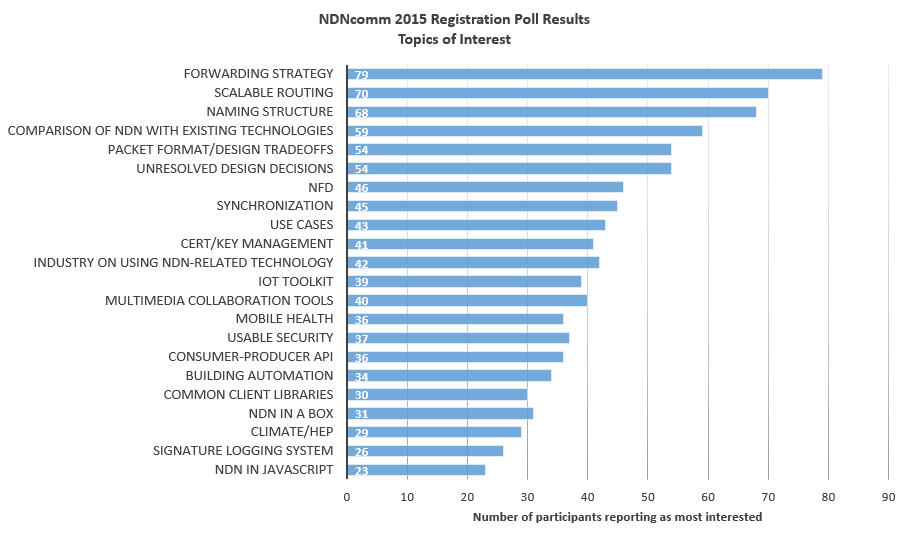
Top 3: Forwarding Strategy, Scalable Routing, Naming Structure


Side event: ACM Conference on Information-Centric Networking (ICN 2015)

In the days right after NDNcomm 2015, the 2nd ACM Conference on Information-Centric Networking (ICN 2015) will be taking place in San Francisco, CA. Several NDNcomm participants will be heading to ACM ICN 2015. Registration information can be found on the ICN website.


Program Committee

  • Co-Chair: Jeff Burke (UCLA REMAP)
  • Co-Chair: kc claffy (UC San Diego/CAIDA)
  • Patrick Crowley (Washington State University in St. Louis)
  • Christos Papadopoulos (Colorado State University)
  • Eiichi Muramoto (Panasonic R&D)
  • Tamer Refaei (The MITRE Corporation)
  • Eve Schooler (Intel)
  • Lan Wang (University of Memphis)
  • Lixia Zhang (UCLA)
  • Steve DiBenedetto (Colorado State University)
  • Jeff Thompson (UCLA REMAP)
  • Alexander Afanasyev (UCLA)
  • Vince Lehman (University of Memphis)

Travel Support for students

Travel support is available for full-time students attending the NDN Community Meeting (NDNComm 2015) and NDN Hackathon. Funds for these travel grants are provided by the NDN Consortium.

Travel Grant Application

Grants are available only for full-time students registered for the meeting. Minority and women students from diverse institutions are particularly encouraged to apply. Preference will be given to those presenting at the meeting. To apply and compete for a travel grant, the student applicant should email the following to ndn-registration@caida.org:

  1. The applying student's curriculum vitae (CV)
  2. An application letter which should include:
    1. A brief summary of the student research interests and accomplishments to date
    2. A statement about why the NDNComm attendance is important to the student
    3. An estimate of the following costs of attending NDNComm: airfare, hotel and meals. It is anticipated that travel grants will partially cover these costs of attendance.
    4. A statement of whether the student has registered for the meeting and proposed to present a paper, poster, etc. in the registration form.
  3. A recommendation letter from the advisor of the student applicant is also required. The letter should provide the following:
  4. A confirmation that the student is a bona fide Ph.D. candidate or a M.Sc./B.Sc. student in good academic standing at the given institution.
  5. An indication about how the student applicant would benefit from attending NDNComm.
  6. A statement of financial commitment to pay the remainder of the student applicants' travel cost not covered by the grant.

The advisor's letter should be emailed to ndn-registration@caida.org.

  • Important Dates for travel support

  • Travel Grant Application Submission Deadline: August 21, 2015

  • Travel Grant Award Notification: August 28, 2015

  • Deadline to Accept/Decline Travel Grant Award: September 4, 2015


  • Local Arrangements / Getting to UCLA

  • Meeting Room The meeting will be held in Little Theater in Macgowan Hall on the UCLA campus. The UCLA website provides directions to Macgowan Hall from the east entrance of campus, and a UCLA Campus Map shows Little Theater and its surroundings.

  • Street Address / Taxi Dropoff The address of Macgowan Hall for GPS and taxi dropoff is 245 Charles E Young Drive East, Los Angeles, California 90095.

  • Self Parking Parking Structure 3 on Charles E. Young Dr East is closest to Macgowan Hall and the Little Theater. The standard parking fee is $12 for an all-day pass, from the pay stations in the parking structure.

  • Airport Shuttle The LAX FlyAway Shuttle is an hourly nonstop bus shuttle from LAX airport to a stop on the south end of UCLA campus , 1.5 miles from Macgowan hall for $10 one-way (credit card only, no cash accepted).

  • Recommended Accomodations

  • International Visitors: Visa Letter of Invitation

    Please be aware that in order to attend NDNcomm 2015 you may need a visa to enter the United States. Attendees are responsible for attaining their own visas, but we can assist by providing a letter of invitation if your local consular office requires it.

For transportation concerns, general questions and help, contact ndn-registration@caida.org

Support for NDNcomm 2015

NDNcomm 2015 is supported by the contributions of industry members of the Named Data Networking Consortium, including Alcatel-Lucent, Brocade, Cisco Systems, Fujitsu Laboratories of America, Huawei Technologies, Intel Corporation, Juniper Networks, Panasonic Corporation, Verisign, Inc., ViaSat. Local arrangements are in cooperation with the UCLA School of Theater, Film and Television, UCLA Network Operations Center, and UCLA Internet Research Laboratory. NDN research is partially supported by the National Science Foundation (Award CNS-1345318 and others).


Additional Content

NDNcomm 2015: Participants

This page contains the list of participants of the second NDN community meeting (NDNcomm 2015) on September 28-29, 2015.

NDN Community Meeting (NDNcomm 2015) Visa Letter of Invitation

Attendees are responsible for attaining their own visas

Please be aware that in order to attend NDNcomm 2015 you may need a visa to enter the United States. We encourage you to contact the Consular Section of the Embassy or Consulate near your location to determine how to apply, and the likely time required for the process of visa issuance. NDNcomm 2015 has no influence over the issuance of a visa.